Press kit no. 1527-15
Journalists, explore this publication-ready project. Create a free v2com media account to download high-resolution images.
Create a media account
Press Kit | no. 1527-15
L'Échouage Residence
Bourgeois / Lechasseur architects
Grounding is a deliberate nautical maneuver that consists in allowing a vessel to rest on the seabed or along the shoreline. Dependent on the tides, it requires a precise understanding of their rhythms before guiding the bow toward land. Anchoring ensures the boat’s stability, while hauling allows it to be steered back on course as the tide returns. In step with the tides…
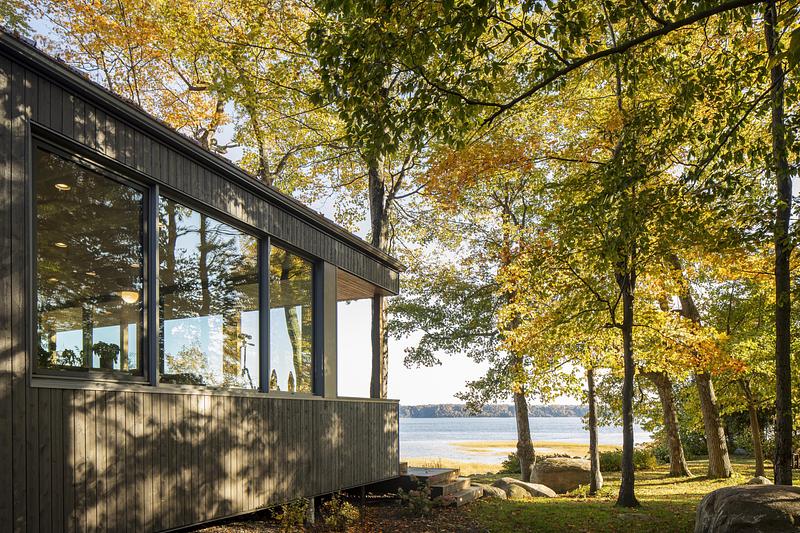
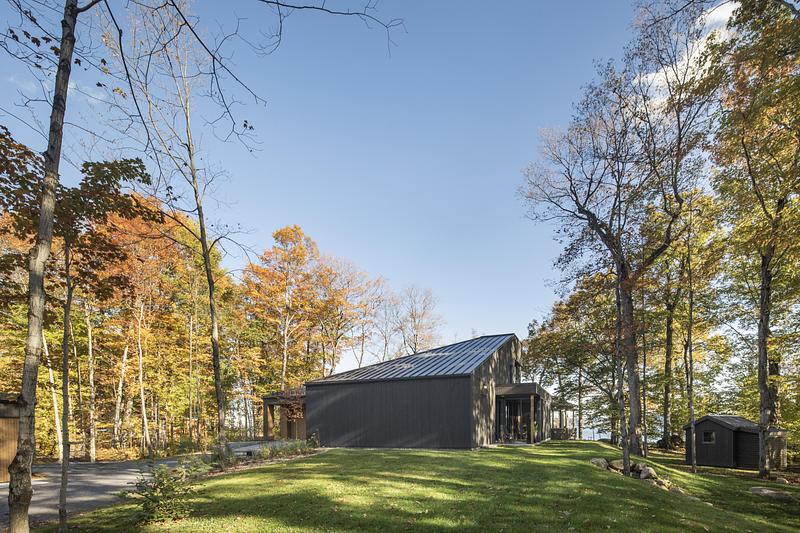
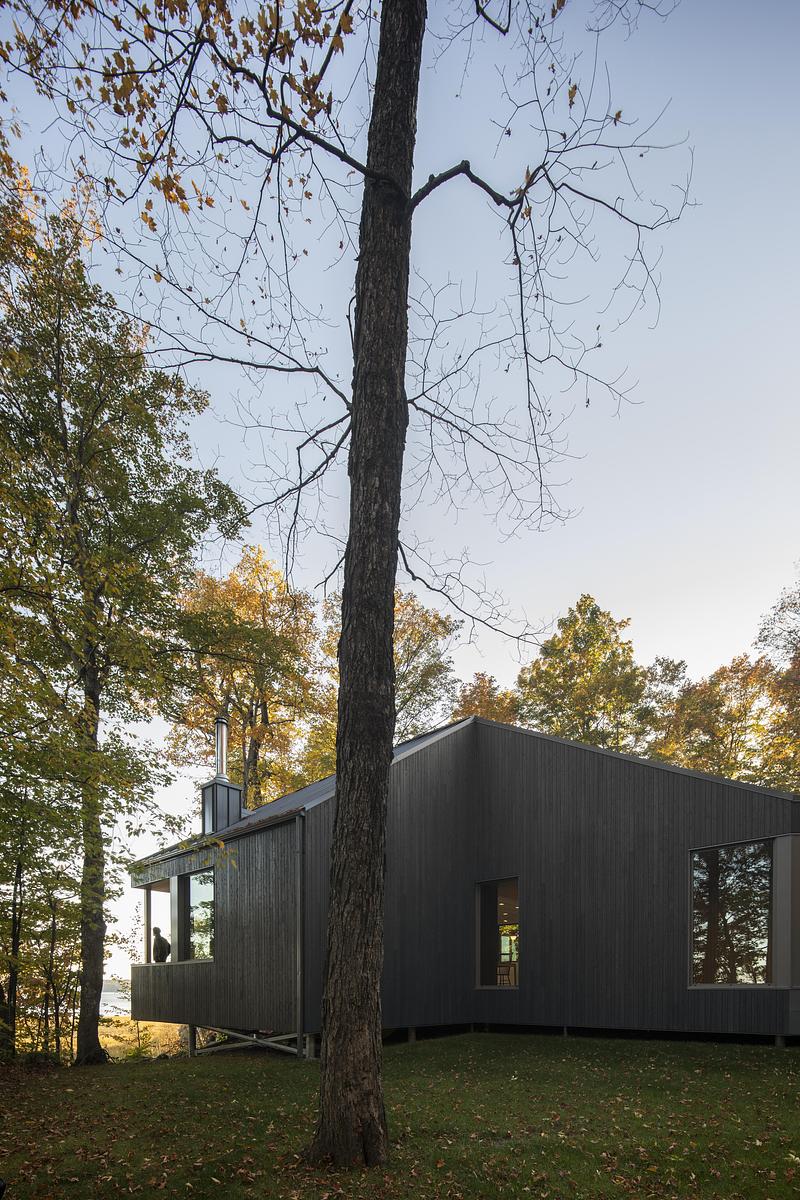
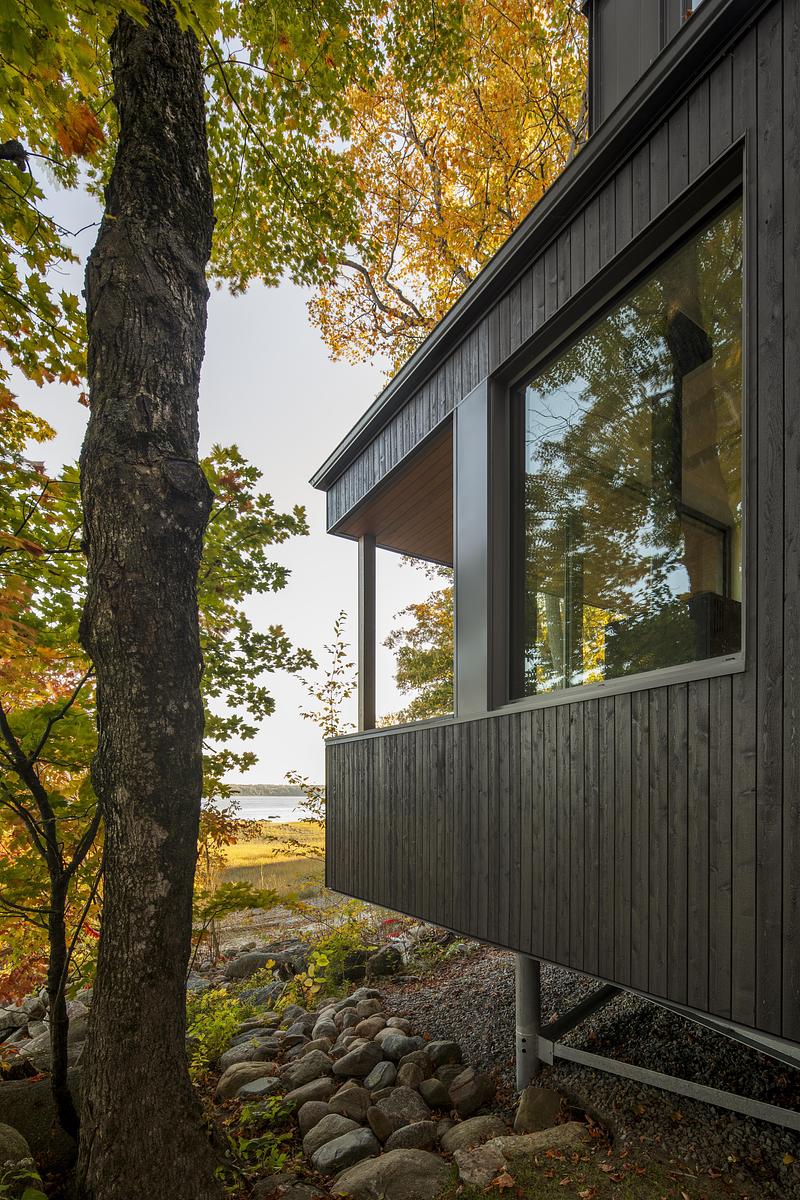
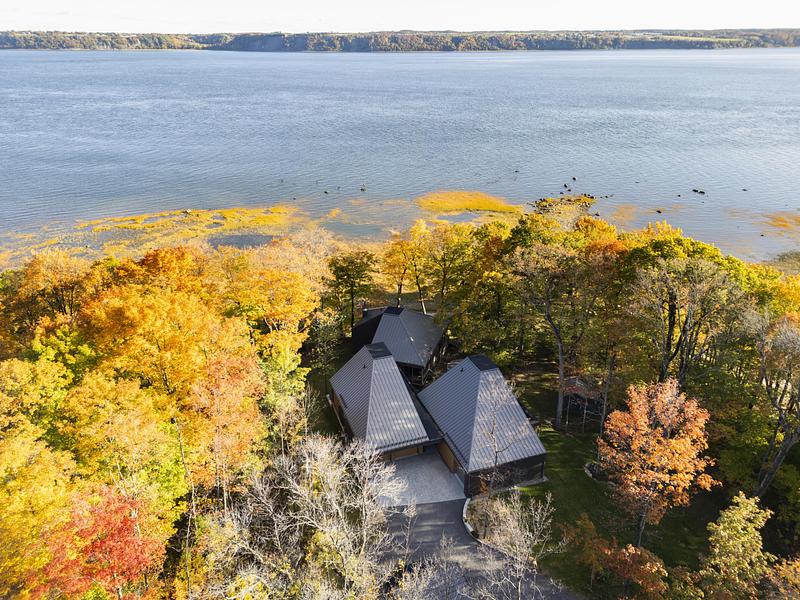
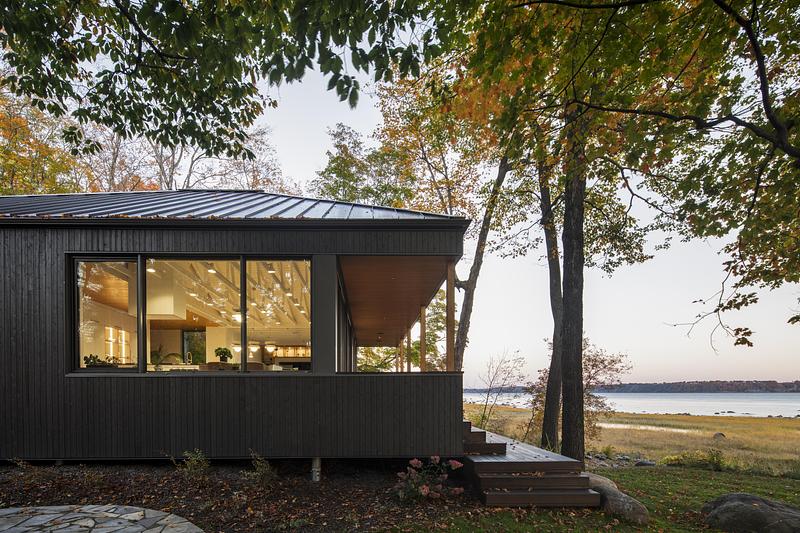
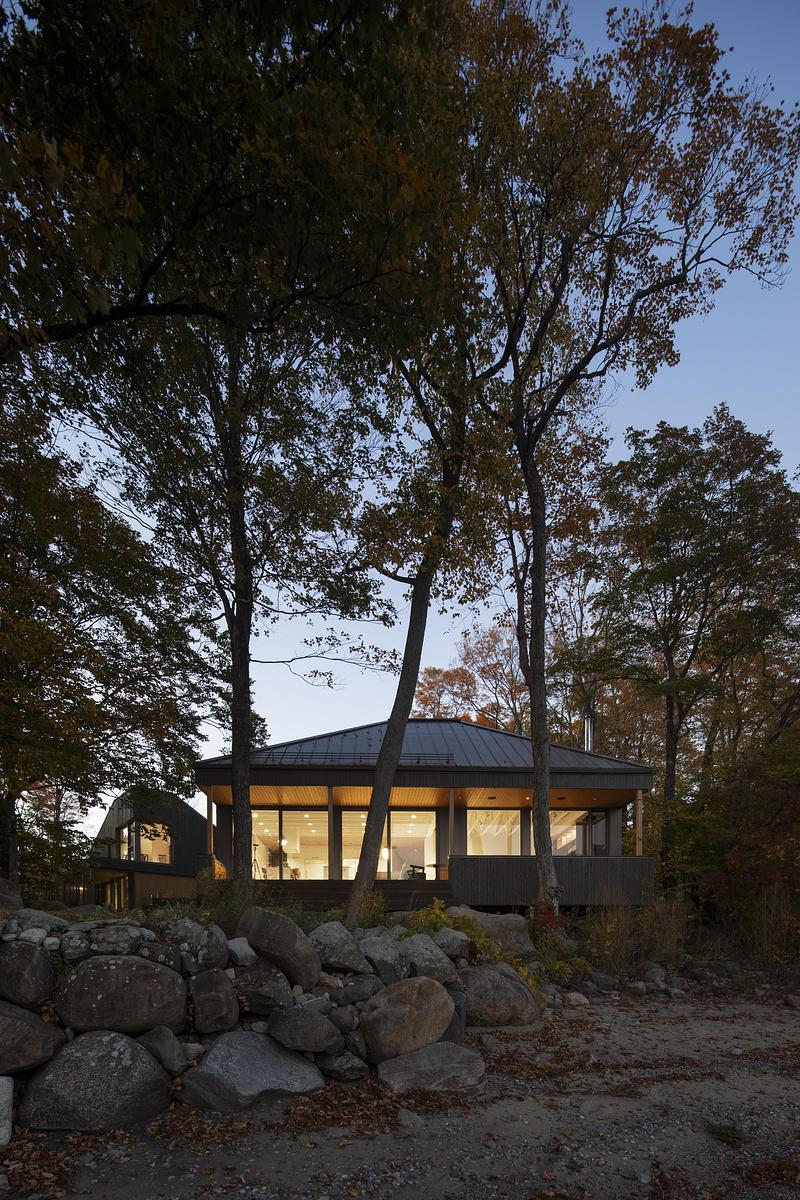
Located on a narrow point of land along the north shore of the St. Lawrence River, the project unfolds within a singular landscape bordered by two sandy bays and scattered erratic boulders. A small summer cottage already occupied the site, set close to the water’s edge. Its direct relationship with the river, reinforced by a cantilevered position above the tides and by the intimacy provided by the surrounding maple grove, represented a spatial and sensory legacy that became central to the project’s development.
The initial commission called for the demolition of the existing cottage and the construction of a new residence. However, during the first site visit, the designers were captivated by both the site and the cottage itself and quickly chose to preserve the structure. The cottage’s formal simplicity, its covered terrace facing the horizon, and the quality of its siting prompted a shift in strategy: to restore the existing building to retain its grandfathered rights, and to discreetly extend it through an addition connected by a bridge.
Despite the site’s generous size, the buildable area is severely limited by rising water levels and by the shoreline protection setback, whose irregular boundaries structure the project’s footprint. These constraints led to a fragmented composition consisting of distinct pavilions located within the permitted zone, while maintaining the cottage in its nonconforming position, hovering above the river.
Preserving the existing cottage required substantial interventions: lifting the structure to install new piles, reinforcing the floors, walls, and roof, and fully insulating the building envelope. Raising the cottage also provides improved resilience in response to fluctuations in water levels.
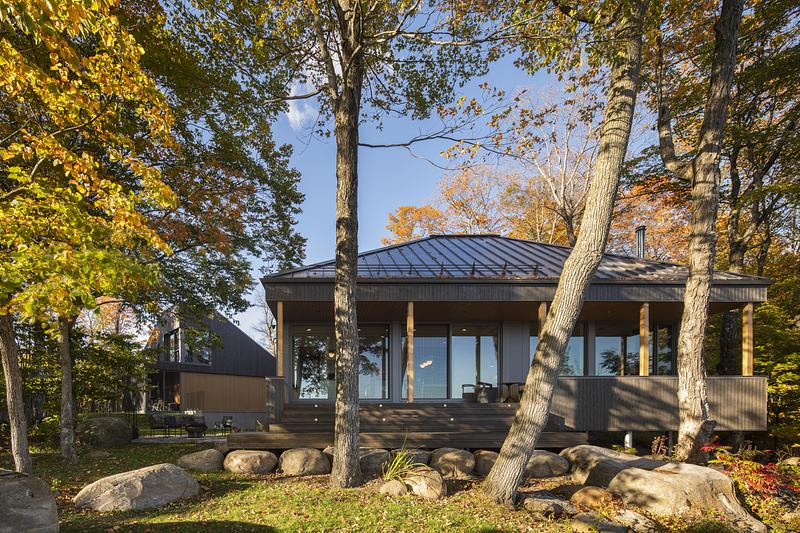
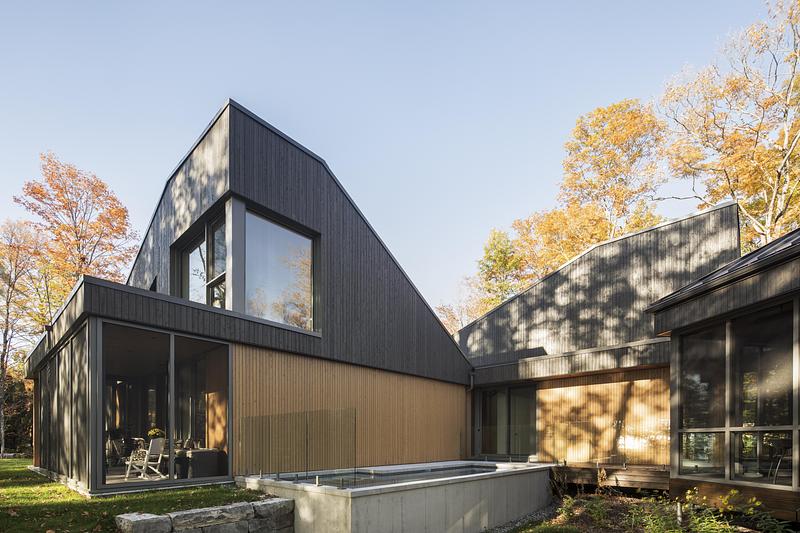
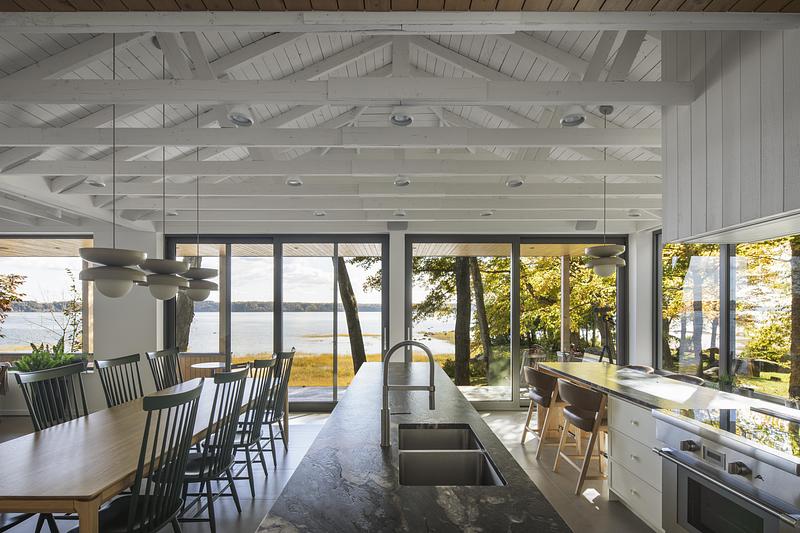
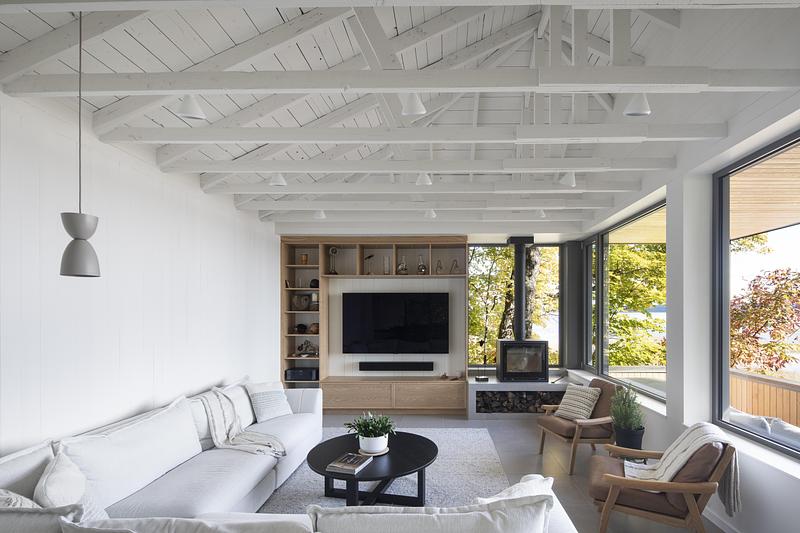
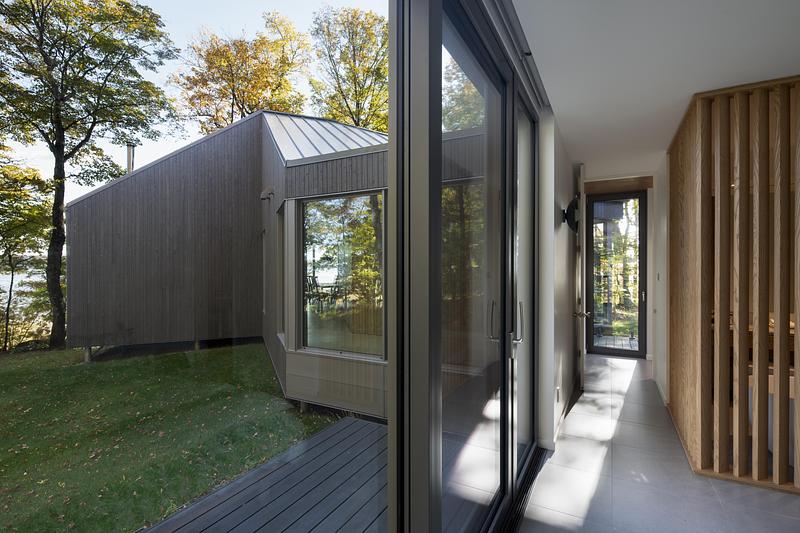
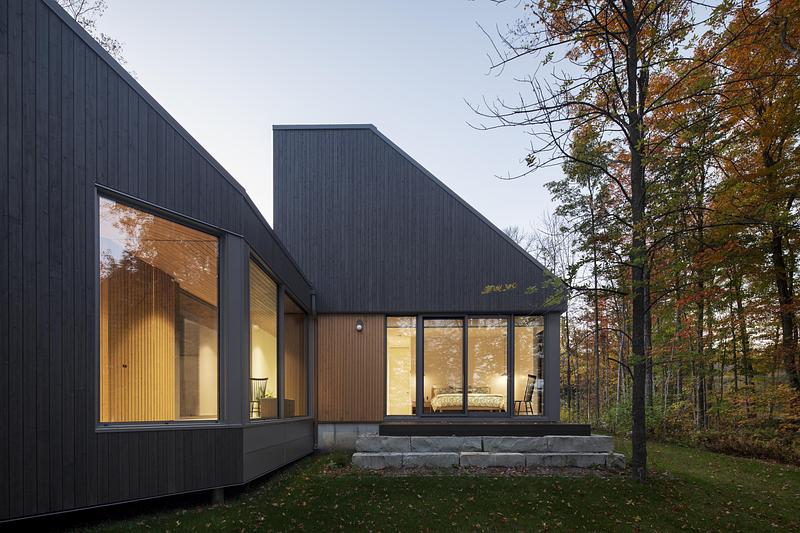
The architectural concept is based on a programmatic sequence of pavilions connected by a floating walkway above the setback. The original cottage houses the main living spaces, fully oriented toward the river and flooded with natural light. The east pavilion, subtly rotated to capture the morning sun, contains the primary bedroom set apart from the communal areas, while a third volume accommodates an accessory dwelling unit for the client’s parents, oriented toward the western bay. This volumetric articulation enables harmonious cohabitation, while ensuring privacy for each unit.
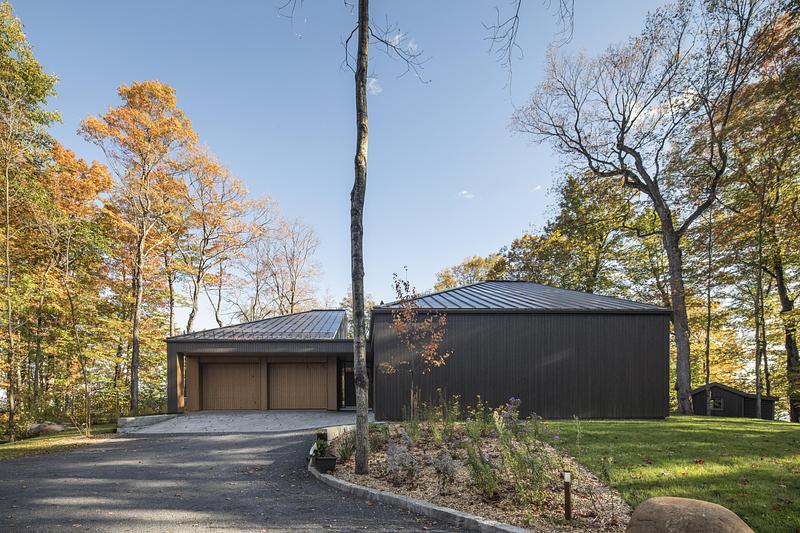
The massing of the new pavilions draws inspiration from the articulation of the cottage’s rooflines: the forms evoke both beached boat hulls and the rocks scattered across the site by the movement of the tides. The fragmentation of volumes preserves a modest, domestic scale—at ground level, the ensemble reads as a small cottage, while only an aerial view reveals the true extent of the intervention.
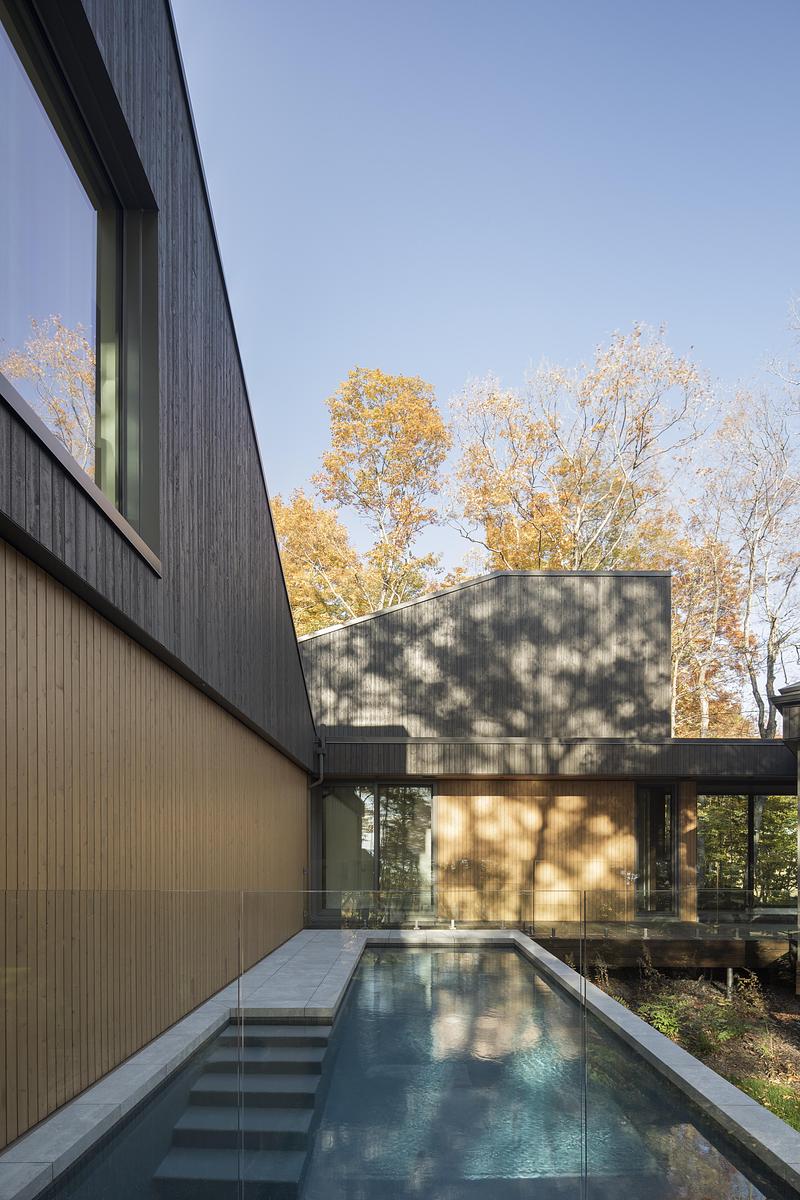
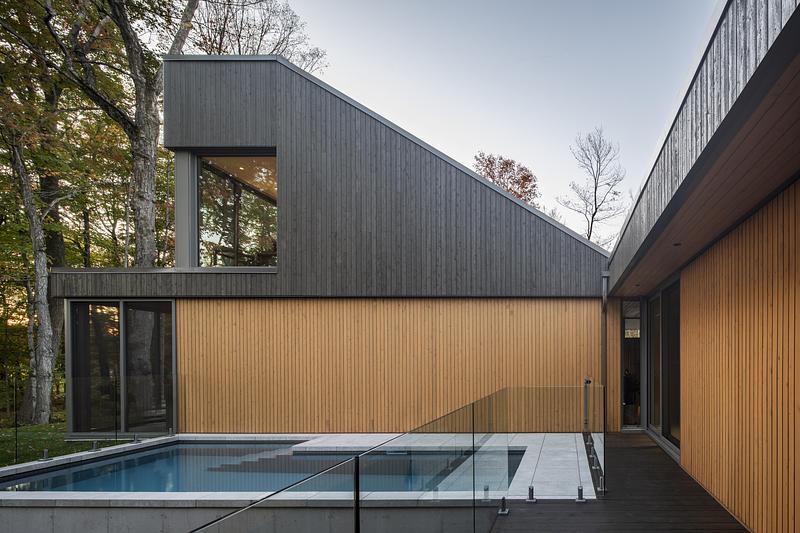
The placement of the volumes also generates a sequence of distinct outdoor spaces. A first courtyard marks the approach to the building and gathers the entrances to both residences. To the west, the angling of the pavilions creates a sheltered inner courtyard, open toward the river and protected from prevailing winds, which accommodates the swimming pool. This configuration forms an intimate, sunlit outdoor room with river views, concealed from the interior spaces and ideally positioned within the regulatory setbacks.
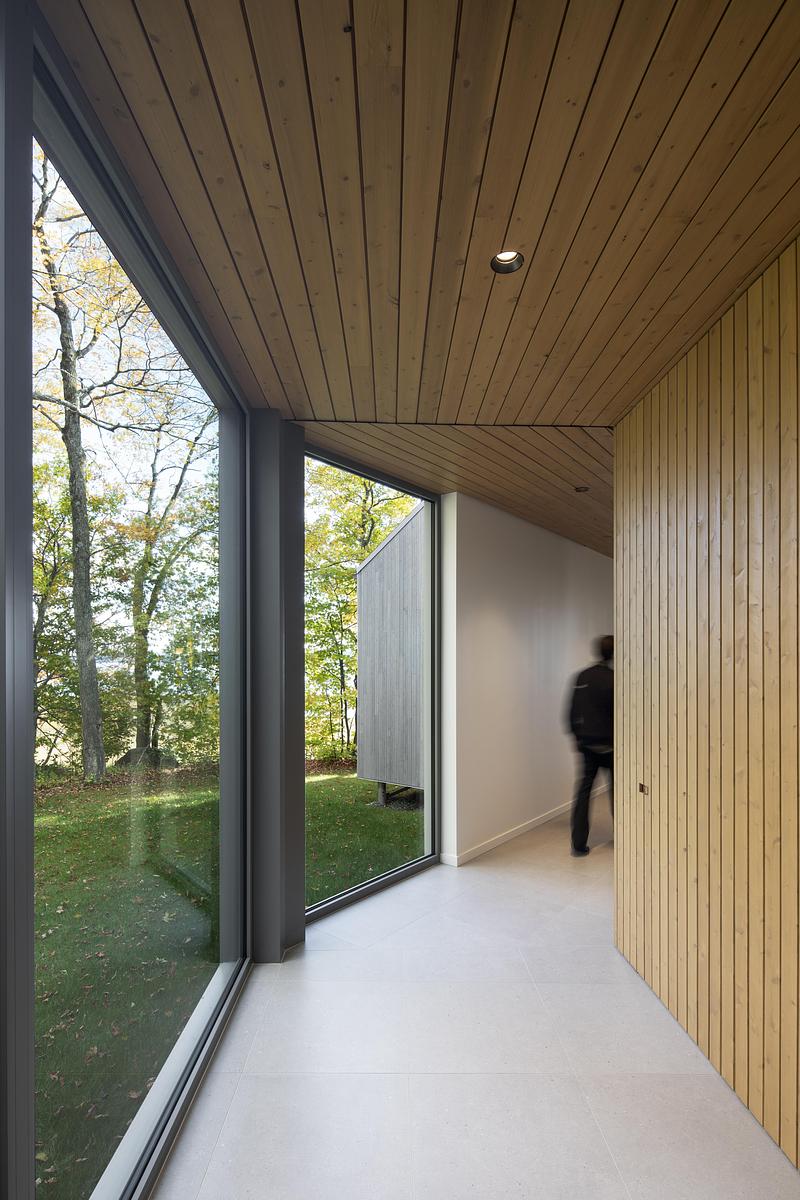
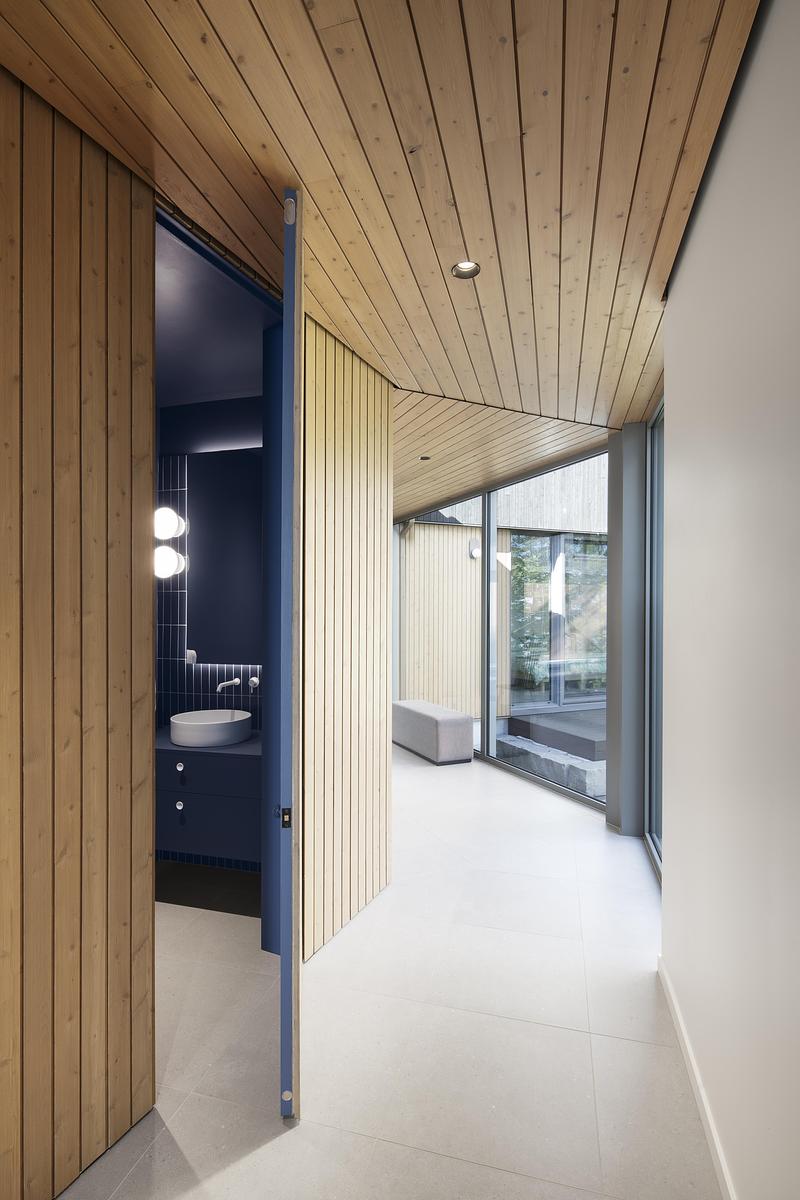
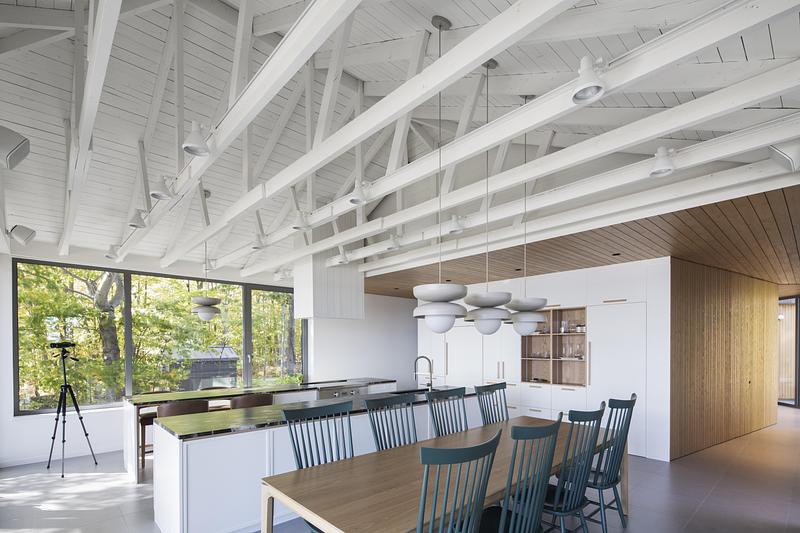
Inside, the project unfolds as a sequence of framed views and cross-perspectives between the pavilions. Each opening reveals a different facet of the landscape, while the bridge introduces a moment of transition and surprise leading toward the original cottage. The living spaces highlight the existing wooden structure, revealed and reinterpreted through a contemporary lens, establishing a dialogue between memory and new intervention.
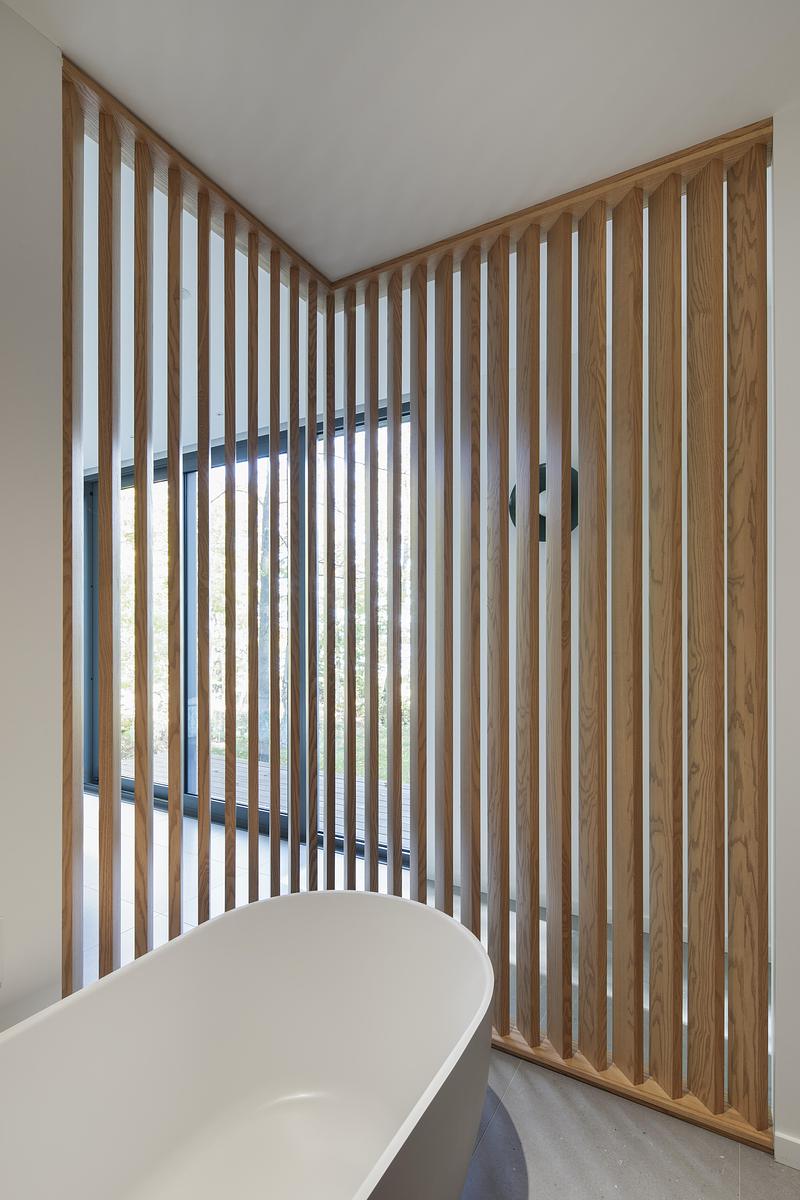
Materiality plays a central role in both the reading of the project and its anchoring within the site. All volumes are clad in cedar siding expressed in two tones. A darker cedar, applied to the primary exterior surfaces, evokes wood naturally weathered by time, echoing the coastal landscape and nearby riverfront structures. In contrast, a lighter, softer cedar appears within volumetric cutouts, recesses, and sheltered areas, accentuating the fragmentation of the masses and the depth of the façades. This pale cedar extends into the interior, reinforcing a sense of transparency and intentionally blurring the boundary between inside and outside, in a material continuity that draws the gaze toward the river.
Technical sheet
Site: St-Augustin-de-Desmaures, Québec
Architects: Bourgeois / Lechasseur architectes
Conception team: Olivier Bourgeois, Régis Lechasseur, Emmanuelle Champagne, Isabelle Auclair, Maxime Turbide, Lisa Hallé
Contractor: Cas par Cas
Photograph: Adrien Williams
About Bourgeois / Lechasseur architects
Since the Quebec firm's founding in 2011, Bourgeois / Lechasseur architects has been attracting attention to its carefully crafted public and private commissions. The architects’ fascination with Quebec’s majestic landscapes, as well as the dramatic cliffs of the Magdalen Islands, has led them to constantly search for innovative solutions, while never losing sight of their roots.
The firm gained notable acclaim for Est-Nord-Est, an international artist residence located 100 kilometers east of Quebec City. Bourgeois / Lechasseur architects have built several projects in the magnificent Charlevoix region, one of Quebec’s most compelling tourist destinations.
For more information
Media contact
- Bourgeois Lechasseur architects
- Olivier Bourgeois, architect
- obourgeois@bourgeoislechasseur.com
- 418-914-0590
Attachments
Terms and conditions
For immediate release
All photos must be published with proper credit. Please reference v2com as the source whenever possible. We always appreciate receiving PDF copies of your articles.
Very High-resolution image : 22.4 x 14.93 @ 300dpi ~ 31 MB
Very High-resolution image : 22.4 x 14.93 @ 300dpi ~ 32 MB
Very High-resolution image : 22.4 x 14.93 @ 300dpi ~ 18 MB
Very High-resolution image : 14.93 x 22.4 @ 300dpi ~ 16 MB
Very High-resolution image : 22.4 x 14.93 @ 300dpi ~ 18 MB
Very High-resolution image : 22.4 x 14.93 @ 300dpi ~ 26 MB
Very High-resolution image : 22.4 x 14.93 @ 300dpi ~ 26 MB
Very High-resolution image : 14.93 x 22.4 @ 300dpi ~ 20 MB
Very High-resolution image : 14.93 x 22.4 @ 300dpi ~ 23 MB
Very High-resolution image : 26.37 x 19.78 @ 300dpi ~ 38 MB
Very High-resolution image : 14.93 x 22.4 @ 300dpi ~ 16 MB
Very High-resolution image : 14.93 x 22.4 @ 300dpi ~ 12 MB
Very High-resolution image : 22.4 x 14.93 @ 300dpi ~ 17 MB
Very High-resolution image : 22.4 x 14.93 @ 300dpi ~ 14 MB
Very High-resolution image : 22.4 x 14.93 @ 300dpi ~ 14 MB
Very High-resolution image : 14.93 x 22.4 @ 300dpi ~ 12 MB
Very High-resolution image : 22.4 x 14.93 @ 300dpi ~ 17 MB
Very High-resolution image : 22.4 x 14.93 @ 300dpi ~ 19 MB
Very High-resolution image : 22.4 x 14.93 @ 300dpi ~ 23 MB
Very High-resolution image : 14.93 x 22.4 @ 300dpi ~ 21 MB


Advertising
You may also like...
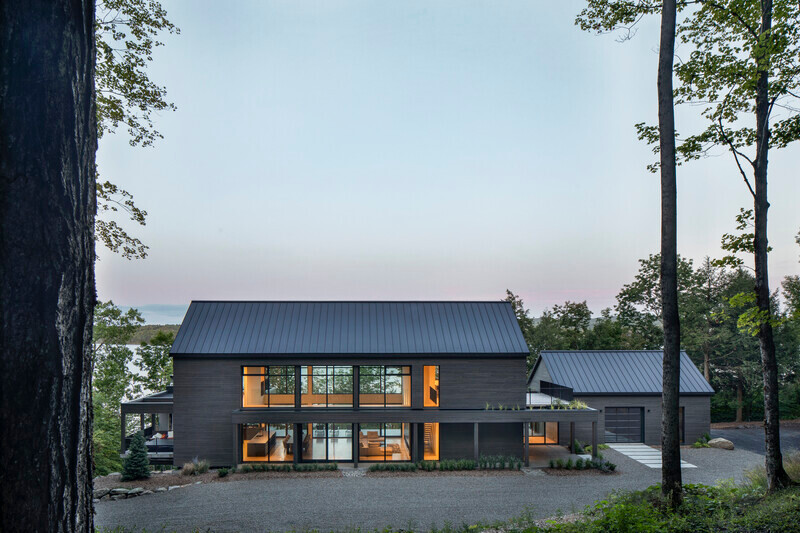
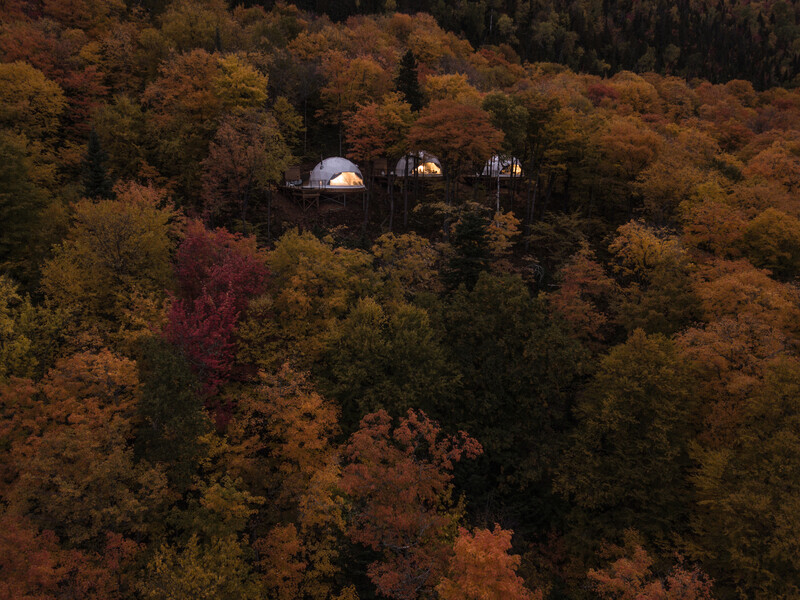
Québec, Canada, 2018-11-06
Eco-Luxurious Accommodations “Dômes Charlevoix"
Bourgeois / Lechasseur architects
Jakarta, Indonesia, 2026-05-29
El House: A Warm Refuge Conducive to Intimate Gatherings
Wahana Architects
Sydney, Australia, 2026-05-19
Bondi Beach Villa Reinterprets the Classical Loggia for Coastal Living
Common Office
Toronto, Canada, 2026-04-14
Montrose Sixplex: A New Housing Model for Gentle Density on a Residential Street in Toronto
Gabriel Fain Architects